

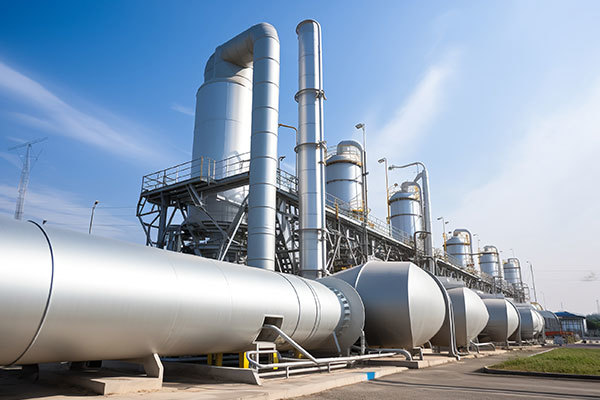


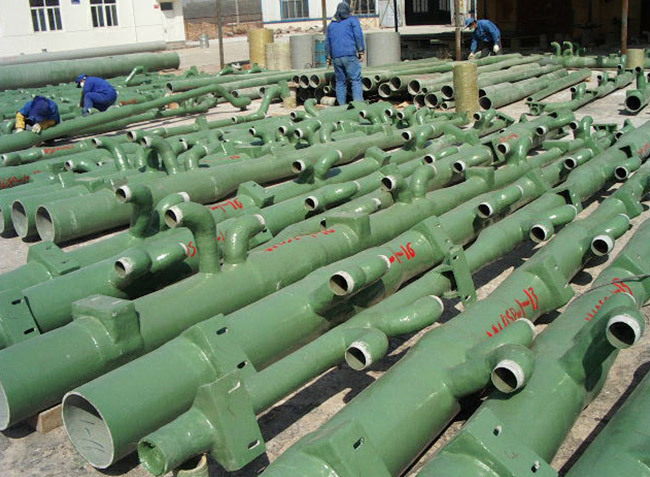
Wear-resistant conveying pipeline
Classification: Products
Keywords: polyester glass steel pipe, polyester glass steel pipe
The main products are: polyester glass fiber reinforced plastic pipe, epoxy glass fiber reinforced plastic pipe, glass fiber reinforced plastic equipment container, tower, flue, glass fiber reinforced plastic pultrusion molding profile and carbon fiber series and other high-performance fiber composite materials.
Wear-resistant conveying pipeline
The wear-resistant conveying pipeline is a new generation of polymer composite conveying pipe with epoxy glass steel pipe as the outer structural layer and polyurethane elastomer as the inner wear-resistant layer, which is both wear-resistant, corrosion-resistant and pressure-resistant. The epoxy glass fiber reinforced plastic structure layer on the outer wall can bear the pressure inside the pipe and resist external corrosion. The inner polyurethane elastomer layer is an anti-wear and corrosion resistant layer, which is firmly bonded to the inner surface of the glass fiber reinforced plastic layer on the outer wall through unique interface treatment, pouring and flanging processes.
1. product performance:It combines the advantages of glass fiber reinforced plastic and polyurethane, and has excellent comprehensive properties such as wear resistance, acid resistance, alkali resistance, anti-scaling, radiation resistance, hydrolysis aging resistance, high elasticity, and mechanical impact resistance.
1. Excellent corrosion resistance and outstanding wear resistance:
The glass fiber reinforced plastic outer structural layer has excellent corrosion resistance, and the outer surface of the pipeline does not need any anti-corrosion treatment under corrosive application environment. The wear-resistant layer of polyurethane lining has high resilience. When high-speed corrosive particles scour the surface of polyurethane elastomer, the polyurethane surface will undergo plastic deformation under pressure. After the external force disappears, polyurethane will return to its original state. This elastic property of "overcoming rigidity with softness" greatly reduces the wear of medium on the polyurethane wear-resistant lining layer, especially in the presence of water, oil and other wetting media under the working conditions, the wear life is often several times to dozens of times that of steel pipes and other non-metallic wear-resistant pipes.
2. Small running resistance and excellent anti-scaling performance:
The surface of polyurethane elastomer is smooth and the absolute roughness is 0.082, which can reduce the running resistance and the conveying pressure and cost. Secondly, polyurethane has a symmetrical molecular structure and is non-polar to the outside. It has no adsorption effect on Ca 2, CO3-2, HCO-3 and OH-plasma in the slurry, forms no scale layer, and has good scale prevention and scale reduction performance.
3. Good interface bonding and controllable thickness of wear-resistant layer:
The pipe structure adopts unique interface treatment and multi-composite technology, the glass fiber reinforced plastic/polyurethane wear-resistant layer interface is firmly bonded, the lining wear-resistant layer is evenly distributed, there will be no shedding, void and local tearing, and the thickness of the polyurethane elastomer lining wear-resistant layer is controllable and adjustable.
4, light weight, transportation, easy installation, low cost:
Since the pipe body is made of glass fiber reinforced plastic as the outer structural layer and polyurethane elastomer as the inner wear-resistant layer, the weight is relatively light, the lifting equipment is simple, and the supporting structure can be simplified, which greatly reduces the transportation, installation and maintenance costs.
2. product specifications:The pipe diameter is DN100 ~ DN600 mm, the length of a single pipe is 6m ~ 12 m, the maximum working temperature is 80 ℃, and the pressure grade is 1.6MPa to 10.0MPa. The connection modes such as thread, socket, flange and flat end are adopted.
3. application areas:It is widely used in dredging, electric power, mining, coal, chemical and other industries to transport mud and sand, coal powder, ash, mineral powder, aluminum liquid, mud and other grinding granular materials and corrosive media.
1, dredging industry: used for port construction and river dredging silt sand transportation.
2. Power industry: ash removal pipeline, ash slag pipeline and ash water recovery pipeline of thermal power plant.
3, mining industry: tailings and mud transportation, underground filling pipeline.
4, metallurgical industry: used for conveying pulp, metallurgical waste, lead particles, aluminum powder and other non-ferrous metal pipeline.
5, coal industry: coal washing plant heavy medium coal preparation and long-distance casting coal pipeline system, coal mining in the sediment backfill pipeline.
6, sea lake salt chemical industry: sea salt, brine transportation.
4. execution standard
JC/T552-2011 Filament Wound Reinforced Thermosetting Resin Pressure Pipe
SY/T6266 Specification for Low Pressure Fiberglass Line Pipe
GB/T 528-2009 Rubber, Vulcanized or Thermoplastic-Determination of Tensile Stress-Strain Properties
GB/T 529-2008 "vulcanized rubber or thermoplastic rubber-determination of tear strength"
GB/T 1458-2008 "fiber wound reinforced plastic ring test method for mechanical properties"
GB/T 5349-2005 "fiber reinforced thermosetting plastic pipe axial tensile properties test method"
JB/T 7705-1995 "loose abrasive wear test method rubber wheel method"
BS EN 1465-1995 Adhesives-Determination of the tensile and rolling shear strength of rigid-to-rigid bonded assemblies
Forging is a processing method that uses forging machinery to apply pressure to metal blanks to produce plastic deformation to obtain forgings with certain mechanical properties, certain shapes and sizes. Forging (forging and stamping) is one of the two major components. Forging can eliminate the defects such as loose casting in the smelting process and optimize the microstructure. At the same time, due to the preservation of the complete metal flow line, the mechanical properties of forgings are generally better than castings of the same material. Related machinery in high load, severe working conditions of important parts, in addition to the shape of a relatively simple available rolling plate, profile or welding parts, the use of forgings.
Previous Page
Previous Page
Related Downloads
Related Products

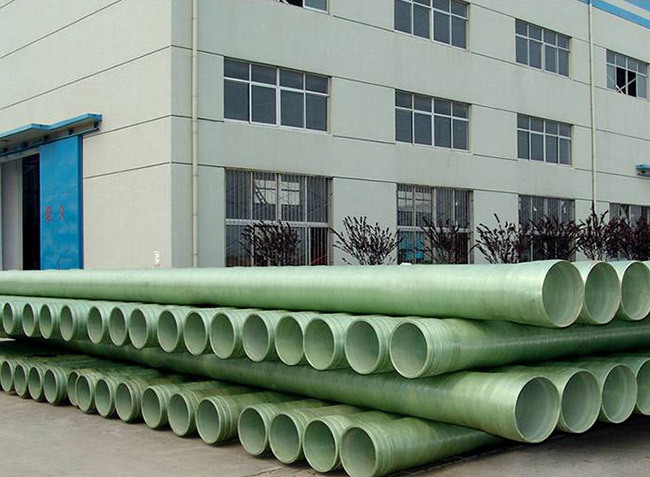
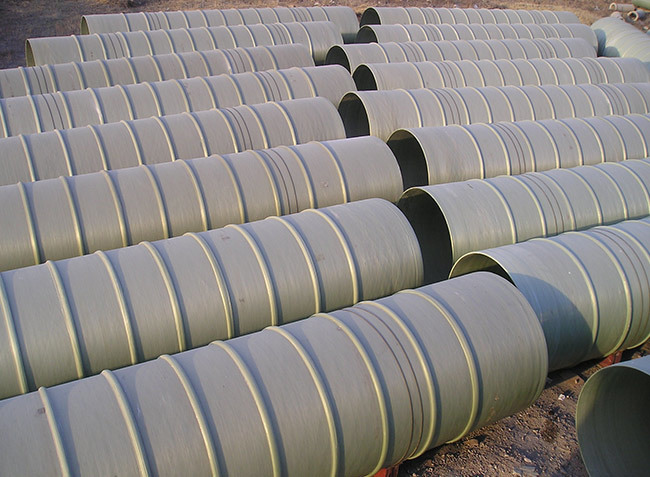
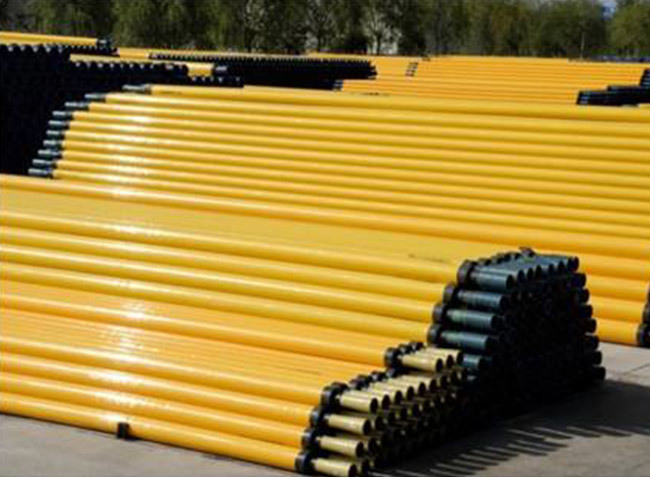
Online consultation

Pay attention to WeChat public number
Copyright©2023 Anhui xinhe new material co.,ltd | Business License | Powered By:300.cn | SEO
 025-57492608


